
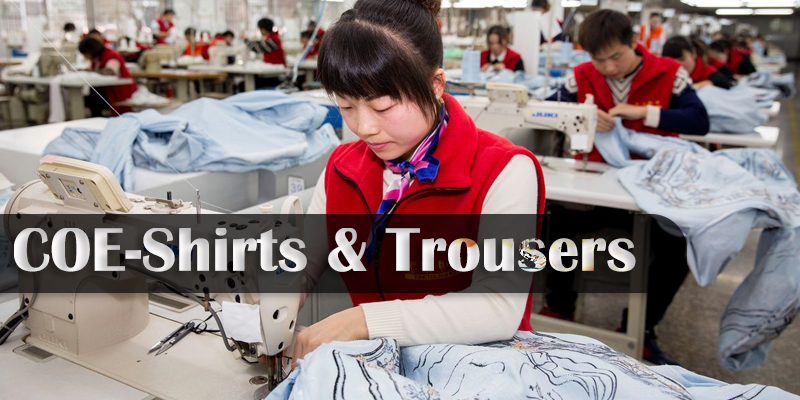
COE-Shirts & Trousers
Syllabus:
Trade Type:
LEARNING OUTCOME
The following are minimum broad Common Occupational Skills/ Generic Learning Outcome after completion of the Cutting and Sewing Machine Operator course of 01 years duration under ATS.
Block I:-
- 1. Recognize & comply safe working practices, environment regulation and housekeeping.
- 2. Select and ascertain measuring instrument and measure dimension of components and record data.
- 3. Explain the concept in productivity, quality tools, and labour welfare legislation and apply such in day to day work to improve productivity & quality.
- 4. Explain energy conservation, global warming and pollution and contribute in day to day work by optimally using available resources.
- 5. Explain personnel finance, entrepreneurship and manage/organize related task in day to day work for personal & societal growth.
- 6. Plan and organize the work related to the occupation.
SPECIFIC LEARNING OUTCOME
Block – I
- 1. Practice and understand precautions to be followed while working.
- 2. Prepare different types of documentation as per industrial need by different methods of recording information.
- 3. Perform sewing machine operation. Dismantle and assemble sewing machine. Check functions and oiling of sewing machines
- 4. Use trade related tools.
- 5. Explain trade terminology.
- 6. Draft different types of basic paper pattern.
- 7. Identify& handle different types of fabrics and texture.
- 8. Prepare sample pieces of hand and machine stitches.
- 9. Plan & select colour combination.
- 10. Press cotton, terylene and silk garments.
- 11. Correct Handle of Different kinds of garment industrial machines related to cutting, sewing, finishing, packing, and special operations.
- 12. Make draft, pattern, layout, & cut stitch, finish, press and pack gent’s shirts, safari shirts gent’s jackets from denim, pleated pant, one-piece narrows bottom pant, Bell bottom pant Jeans Cargo pant
Note: Learning outcomes are reflection of total competencies of a trainee and assessment will be carried out as per assessment criteria.
ON-JOBTRAINING
BROAD LEARNING TO BE COVERED IN INDUSTRY FOR SHIRT ANDTROUSER MAKER TRADE:
- 1. Safety and best practices /Basic Industrial Culture (5S, KAIZEN, etc.)
- 2. Record keeping and documentation.
- 3. Handle trade related tools & equipment in industry:- Measuring, Drafting, Cutting, Finishing, Pressing
- 4. Correct handling of all types of Sewing machines & their operations:
- A. Single needle high speed industrial straight lock stitch machine / computerized
- B. Twin needle feed lock stitch with thread trimmer
- C. Single needle, 2 thread ultra-high speed over lock sewing machine.
- D. Double needle feed off arm
- E. Single needle flatbed double chain stitch hed
- F. 5 thread over lock machine with safety stitch
- G. Electronic buttonhole machine / computerized
- H. Electronic bar tacking machine
- I. Single needle zigzag machine/computerized
- J. Button stitch machine/computerized
- K. Belt attaching machine with belt folder
- L. Elastic attaching machine
- M. Twin needle 3 threads flat bed covering stitches with front cutter for making belt 100 pcs.
- N. Blind stitch machine
- O. Double needle patch pocket fixing machine
- P. Collar stitching & turning machine
- Q. Cuff stitching & turning machine
- R. Fusing machine
- S. Vacuum pressing machine
- T. Stain removing machine etc
- 5. Draft, make paper pattern, layout, estimate, cut Gent’s shirts, Safari shirts Gents (Half & Full Sleeves) jackets from denim, Pleated pant, One-piece narrows bottom pant, Bell bottom pant, Jeans , Cargo pant with given size.
- 6. Main skills involved- making & fixing different types of collar, cuffs, pockets yokes etc. Lay planning of components according to design of fabric such as checks, stripes, texture
- 7. Assemble all cut component, finish, press , check fitting and alter using different industrial machines for each purpose.
- 8. Pack mentioned garments.
Note: Actual training will depend on the existing facilities available in the establishments. The competencies/ specific outcomes on completion of On-Job Training are detailed
Block – I
- 1. Practice and understand precautions to be followed while working.
- 2. Recognize & comply safe working practices, environment regulation and housekeeping.
- 3. Select and ascertain measuring instrument and measure dimension of components and record data.
- 4. Explain the concept in productivity, quality tools, and labour welfare legislation and apply such in day to day work to improve productivity & quality.
- 5. Explain energy conservation, global warming and pollution and contribute in day to day work by optimally using available resources.
- 6. Explain personnel finance, entrepreneurship and manage/organize related task in day to day work for personal & societal growth.
- 7. Prepare different types of documentation as per industrial need by different methods of recording information.
- 8. Perform sewing machine operation. Dismantle and assemble sewing machine Check functions and oiling of sewing machines
- 9. Use trade related tools.
- 10. Explain trade terminology.
- 11. Draft, make different type of basic paper pattern. Identify& handle different type of fabrics and texture.
- 12. Prepare sample pieces of hand and machine stitches.
- 13. Plan & select colour combination.
- 14. Press cotton, terylene and silk garments.
- 15. Correct Handle of Different kind of garment industrial machines related to cutting, sewing, finishing, packing, and special operations.
- 16. Make draft, pattern, layout, & Cut stitch, Finish, Press and Pack gent’s shirts, safari shirts gent’s jackets from denim, Pleated pant One-piece narrows bottom pant, Bell bottom pant. Jeans, Cargo pant.
- Industry must ensure that above mentioned competencies are achieved by the trainees during their on job training.
- In addition to above competencies/ outcomes industry may impart additional training relevant to the specific industry.

| Workshop Calculation Semester 1 Jan 2018 |
| Workshop Calculation & Science Sem 2 Jan 2018 |
| Workshop Calculation Semester 3 July 2018 |
| Workshop Calculation Semester 3 Jan 2018 |

| Engg Drawing Semester 1 July 2017 |
| Engg Drawing Semester 4 July 2018 |
| Engg Drawing Semester 4 July 2017 |
| Engg Drawing Semester 4 January 2018 |
| Engg Drawing Semester 3 July 2018 |

Employability Skills Work Book
- AI को समझना
- AI कैसे काम करता है?
- AI क्या कर सकता है?
- AI के प्रकार
- AI से जुड़े करियर के बारे में जानना
- AI के साथ सीखना
- AI का ज़िम्मेदारी से इस्तेमाल
- AI क्या है?
| आईटीआई एम्प्लॉयबिलिटी स्किल्स 2019 - प्रश्न पत्र सेट 23 |
| आईटीआई एम्प्लॉयबिलिटी स्किल्स 2019 - प्रश्न पत्र सेट 24 |
| आईटीआई एम्प्लॉयबिलिटी स्किल्स 2019 - प्रश्न पत्र सेट 25 |

Search engine adsence
Funny Video Play
students Behaviour in exam hall