
Instrument Mechanic
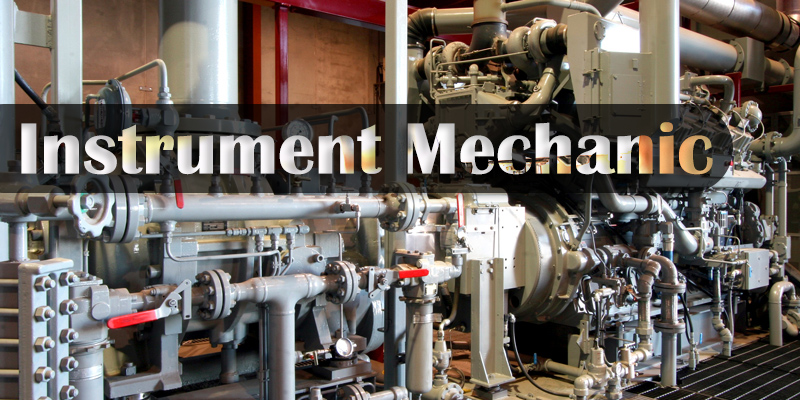
ITI trade Instrument Mechanic is powered by NCVT. ITI trade Instrument Mechanic is a job oriented trade ITI trade Instrument Mechanic is suitable for government job and private job. This ITI trade Instrument Mechanic is very powerful for self-empowerment. This ITI trade Instrument Mechanic is perfectly design to fulfill industrial requirement of Indian Industries as well as International industries.
Mechanic Precision Instrument, General; tests, repairs, overhauls and assembles various precision instruments and their parts for efficient performance. Examines instrument for defects. Dismantles components and cleans them in appropriate fluid such as petrol, kerosene etc. to find out extent of damage or wear and tear to parts. Removes minor defects of parts by grinding, filing, drilling, etc. and replaces worn out and damaged parts. Adjusts position of various parts using screwdriver, spanner etc. and assembles instrument to form complete unit. Makes simple electrical connections, solders contact points and performs other tasks as necessary. Tests performance either by visual observation or by conducting simple electrical and mechanical tests and ensures that repaired or assembled instrument conforms to prescribed efficiency. May make new components and assemble new instruments. May specialize in any particular type of instrument like mechanical, hydraulic, pneumatic, electrical, optical, orthopedic etc.
Technician Instrumentation; dismantles removes and replaces a range of instruments and faulty peripheral components down to unit and component level, setting up test equipment, troubleshooting components of instruments, calibrating them and also preparing service reports and accurately documenting parts replacement and repair.
Mechanic Precision Instrument, Mechanical; makes, alters and adjusts mechanical instruments or mechanical parts of electrical and optical instruments by accurate milling, filing, grinding, lapping and other processes. Studies drawings or samples and examines precision instrument like balance, meters, pressure gauges etc. for defects. Dismantles instrument, cleans metal components in petrol, kerosene oil or otherwise and checks them to find out extent of damage and further serviceability. Makes new parts on lathe milling or other machines, if necessary. Sizes and fits metal parts by filing, scraping, grinding lapping etc. as necessary and ensures their desired accuracy by checking with precision measuring instruments shadow graph and other highly perfect devices. Assembles parts to form complete unit. Gets electrical components repaired by Electrician. Fits electrical and optical parts to instrument and adjusts them as required. Texts repaired or assembled instrument for clarity or vision sensitivity, correct meter and scale readings etc. as required and ensures stipulated performance within prescribed limits. Makes necessary adjustments and seals meters to avoid manipulations. May specialize in particular type of instruments like balance, pressure gauges, meters, the odolites etc. May make new instruments from blue prints.
Functional Tester; is responsible for checking functions of manufactured industrial equipment such as UPS, inverter, energy meter, PLC, oscilloscope, control panel. The individual at work tests specified functions of every product being assembled on the production line.
During the two-year duration of Instrument Mechanic trade a candidate is trained on professional skill, professional knowledge, Engineering Drawing, Workshop Calculation & Science and Employability skill. In addition to this a candidate is entrusted to undertake project work and extracurricular activities to build up confidence. The broad components covered related to the trade are categorized in four semester of six months duration each. The semester wise course coverage is categorized as below:-
1 st Semester – In this semester the trainee learns about safety and environment, use of fire extinguishers, artificial respiratory resuscitation to begin with. He gets the idea of trade tools & its standardization, Familiarize with basics of electricity, construction of PMMC & MI instruments. Overhauling and testing & calibration of ammeters, voltmeters, wattmeter and ampere-hour meter of various types, meter sensitivity, accuracy, maximum power, capability etc. Test the cable and measure the electrical parameter, experiments on transformer, measuring current and voltage in primary and secondary windings filing practice, marking & measuring with the help of Vernier Caliper, Vernier Height Gauge. Skilling practice on different types & combination of cells for operation and maintenance of batteries being done. Identify and test passive and active electronic components. Construct and test unregulated and regulated power supplies. Practice soldering and de-soldering of various types of electrical and electronic components on through hole PCBs and different type of switches, application like buzzers, solenoid valves.
2 nd Semester – In this semester the candidate will be able to construct and test different types of diode, V-I characteristics, rectifiers, amplifier, op-amps, oscillator and wave shaping circuits. Testing of power electronic components. Construct and test power control circuits. Identify and test opto electronic devices. Able to achieve the skill on SMD Soldering and De-soldering of discrete SMD components. Verifying the truth tables of various digital ICs by referring Data book. Verification of truth tables of various logic gates, RS and JK flip flops, Counters, BCD to decimal decoder, 7 segment display circuits, D/A and A/D circuit, RS485 to RS232 converter. Practice circuit simulation software to simulate and test various circuits. Assemble a computer system, install OS, Practice with MS office. Use the internet, browse, create mail IDs, download desired data from internet using search engines. Familiarization with microprocessor trainer kit, basic program on microprocessor. Measurement voltage, frequency using CRO, operating storage oscilloscope.
3 rd Semester – In this semester the trainee will be able to study various types of instruments constructions and identify various parts and section. Measuring speed and velocity using various tachometers. Operating stroboscope. Practice on various pressure sensors and pressure gauge. Testing and calibration of various type of pressure measuring instruments, dead weight tester and comparator. Testing and installation of pressure switches. Perform practical on pressure simulator or experimental setup. Operating and calibrating pressure transmitters. Checking various types of flow restrictors and use, D.P. cell/transmitter. Fitting of tapered glass tube checking and testing V- notches fitting, repairing various types of positive displacement flow meters, installation maintenance of flow instruments. Calibrating and installing turbine flow meter, vertex flow meter. Measurement of level performing on level measurement i.e. experimental setup for level measurement process simulator, calibration of level transmitters, level instrument maintenance, repairing and control. Temperature measurement with different sensors and temperature controlled oil bath/furnace for low and high temperature, temperature instrument maintenance and calibration. Primary calibration standards, primary standard instruments, secondary standard instruments, instrument inspection, calibration and test method.
4 th Semester – In this semester the trainee will work with experimental setup/temperature simulator for temperature measurement controls. Thermocouple and RTD experiment on optical pyrometer and radiation pyrometer. Measurement of humidity. Recorders and servicing of pneumatic, electrical/ electronic recorders, study of paperless LCD/LED recorder. Study of control valves/final control elements and its various components. Piping tubing and fitting. Study the cut section of various type of control valves, operation on cascade, ratio, feed forward control trainer. Experiment on PID controller trainer on various process parameters, programmable logic controller trainer, programmes on timers and counters. Installing & operating HART transmitters/devises (I/O). Calibration of HART devices. Work on various network lines, uses of DCS & SCADA complete with communication system on process trainer. Working on Hydraulics and Pneumatics trainer, air filter regulator. Practice on PH meter, conductivity meter, on line measurement of PH, conductivity and dissolved Oxygen.

| Workshop Calculation Semester 1 Jan 2018 |
| Workshop Calculation & Science Sem 2 Jan 2018 |
| Workshop Calculation Semester 3 July 2018 |
| Workshop Calculation Semester 3 Jan 2018 |

| Engg Drawing Semester 1 July 2017 |
| Engg Drawing Semester 4 July 2018 |
| Engg Drawing Semester 4 July 2017 |
| Engg Drawing Semester 4 January 2018 |
| Engg Drawing Semester 3 July 2018 |

Employability Skills Work Book
- AI को समझना
- AI कैसे काम करता है?
- AI क्या कर सकता है?
- AI के प्रकार
- AI से जुड़े करियर के बारे में जानना
- AI के साथ सीखना
- AI का ज़िम्मेदारी से इस्तेमाल
- AI क्या है?
| आईटीआई एम्प्लॉयबिलिटी स्किल्स 2019 - प्रश्न पत्र सेट 23 |
| आईटीआई एम्प्लॉयबिलिटी स्किल्स 2019 - प्रश्न पत्र सेट 24 |
| आईटीआई एम्प्लॉयबिलिटी स्किल्स 2019 - प्रश्न पत्र सेट 25 |
