
Machinist
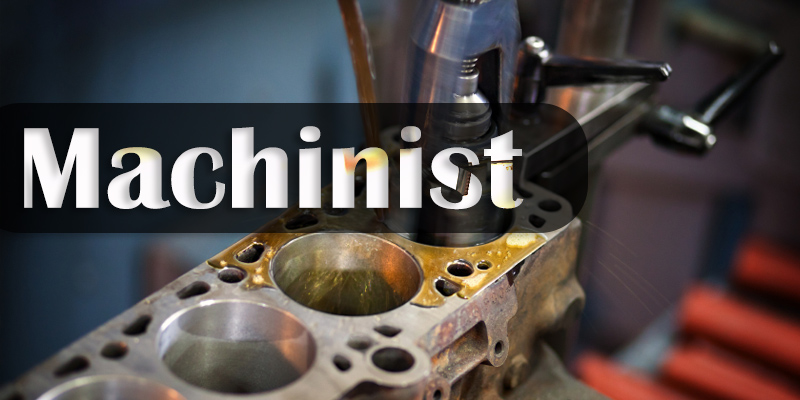
ITI trade Machinist is powered by NCVT. ITI trade Machinist is a job oriented trade ITI trade Machinist is suitable for government job and private job. This ITI trade Machinist is very powerful for self-empowerment. This ITI trade Machinist is perfectly design to fulfill industrial requirement of Indian Industries as well as International industries.
On successful completion of this course, the candidates shall be gainfully employed as:
• Machinist, Grinder, Operator of various types of power driven metal cutting or grinding machines in Production & Manufacturing industries,Infrastructure and defence organizations.
• Machinists have a wide scope of Employability ranging from self-employment, contractual employment to Industrial jobs.
International Comparability
- 1. Comparison Made with German Syllabus and the proposed syllabus is in line with the existing German Syllabus (Around 95% contents are matching).
- 2. However, ITI passed out trainees are getting employment in many Gulf countries, European countries, Australia, New Zealand, Singapore etc.
Progression Pathway
- Can appear in 10+2 examination through National Institute of Open Schooling (NIOS) for acquiring higher secondary certificate and can go further for General/ Technical education
- Can take admission in diploma course in notified branches of Engineering by lateral entry
- Can become supervisor after doing part-time diploma in relevant branch of Engineering.
- Can join Apprenticeship programme in different types of industries leading to National Apprenticeship certificate (NAC) after which they will be employed in industry as skilled worker and can become supervisor after doing part-time diploma in relevant branch of Engineering
- Can join Crafts Instructor Training Scheme (CITS) in the relevant trade after which they will be employed in ITI/ Vocational Training Institute as instructor
Semester – I
- (i) Plan and organize the work to make job as per specification applying different types of basic fitting operation and Check for dimensional accuracy. [Basic fitting operation – marking, Hacksawing, Chiselling, Filing, Drilling, Taping and G
- Produce components by different operations and check accuracy using appropriate measuring instruments.[Different Operations - Drilling, Reaming, Tapping, Dieing; Appropriate Measuring Instrument – Vernier, Screw Gauge, Micrometer]
- Make different fit of components for assembling as per required tolerance observing principle of interchange ability and check for functionality. [Different Fit – Sliding, Angular, Step fit, ‘T’ fit, Square fit and Profile fit; Required tolerance: ±0.2 mm
- Set different shaped jobs on different chuck and demonstrate conventional lathe machine operation observing standard operation practice. [Different chucks: 3 jaws & 4 jaws, different shaped jobs: round, square, hexagonal]
- Prepare different cutting tool to produce jobs to appropriate accuracy by performing different turning operations. [Different cutting tool – V tool, side cutting, parting, thread cutting (both LH & RH), Appropriate accuracy: - ±0.06mm, Different turning o
- Set different components of machine & parameters to produce taper/ angular components and ensure proper assembly of the components. [Different component of machine: Form tool, Compound slide, tail stock offset; Different machine parameters- Feed, speed, d
- Set the different machining parameters to produce metric-v threaded components applying method/ technique and test for proper assembly of the components.
Semester – II
- Set the different machining parameters and cutting tool to prepare job by performing different slotting operation. [Different machining parameters – feed, speed and depth of cut. Different slotting operations–concave & convex surface, internal key ways, p
- Set the different machining parameters and cutters to prepare job by performing different milling operation and indexing. [Different machining parameters – feed, speed and depth of cut. Different milling operations – plain, face, angular, form, gang, stra
- Set the different machining parameters to produce square & “V’’ threaded components applying method/ technique and test for proper assembly of the components.
- Produce components of high accuracy by different operations using grinding. [Different operations – surface grinding, cylindrical grinding with an accuracy of+/- 0.01 mm]
Semester – III
- Resharpen different single & multipoint cutting tool. [Different single point tools, slab milling cutter, side & face milling cutter, end mill cutter and shell end mill cutter.]
- Set different machining parameters and cutters to prepare job by different milling machine operations. [Different machining parameters - feed, speed, depth of cut, different machining operation – facing, drilling, tapping, reaming, counter boring, counter
- Set the different machining parameters and cutters to prepare components by performing different milling operation and indexing. [Different machining parameters – feed, speed and depth of cut. Different components – Rack, Spur Gear, External Spline, Stee
- Identify and explain basic functioning of different electrical equipment, sensors and apply such knowledge in industrial application including basic maintenance work. [Different electrical equipment- multi-meter, transformer, relays, solenoids, motor & ge
- Set (both job and tool) CNC turning centre and produce components as per drawing by preparing part programme.
Semester – IV
- Set (both job and tool) CNC machining centre and produce components as per drawing by preparing part programme.
- Plan and perform simple repair, overhauling of different machines and check for functionality. [Different Machines – Drilling Machine, milling machine and Lathe]
- Set the different machining parameters and cutters to prepare components by performing different milling operation and indexing. [Different machining parameters – feed, speed and depth of cut. Different components – end mill, bevel gear, cam, worm & worm
Generic Learning Outcomes
- Recognize & comply safe working practices, environment regulation and housekeeping.
- Understand and explain different mathematical calculation & science in the field of study including basic electrical. [Different mathematical calculation & science -Work, Power & Energy, Algebra, Geometry & Mensuration, Trigonometry, Heat & Temperature, L
- Interpret specifications, different engineering drawing and apply for different application in the field of work. [Different engineering drawing-Geometrical construction, Dimensioning, Layout, Method of representation, Symbol, scales, Different Projection
- Select and ascertain measuring instrument and measure dimension of components and record data.
- Explain the concept in productivity, quality tools, and labour welfare legislation and apply such in day to day work to improve productivity & quality.
- Explain energy conservation, global warming and pollution and contribute in day to day work by optimally using available resources.
- Explain personnel finance, entrepreneurship and manage/organize related task in day to day work for personal & societal growth
- Plan and organize the work related to the occupation

| Workshop Calculation Semester 1 Jan 2018 |
| Workshop Calculation & Science Sem 2 Jan 2018 |
| Workshop Calculation Semester 3 July 2018 |
| Workshop Calculation Semester 3 Jan 2018 |

| Engg Drawing Semester 1 July 2017 |
| Engg Drawing Semester 4 July 2018 |
| Engg Drawing Semester 4 July 2017 |
| Engg Drawing Semester 4 January 2018 |
| Engg Drawing Semester 3 July 2018 |

Employability Skills Work Book
- AI को समझना
- AI कैसे काम करता है?
- AI क्या कर सकता है?
- AI के प्रकार
- AI से जुड़े करियर के बारे में जानना
- AI के साथ सीखना
- AI का ज़िम्मेदारी से इस्तेमाल
- AI क्या है?
| आईटीआई एम्प्लॉयबिलिटी स्किल्स 2019 - प्रश्न पत्र सेट 23 |
| आईटीआई एम्प्लॉयबिलिटी स्किल्स 2019 - प्रश्न पत्र सेट 24 |
| आईटीआई एम्प्लॉयबिलिटी स्किल्स 2019 - प्रश्न पत्र सेट 25 |
