
Mech. Repair & Maintenance of Light Vehicles
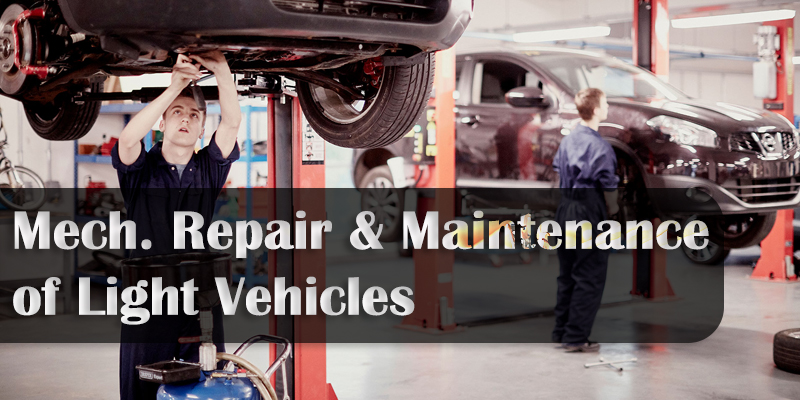
JOB ROLE
Mechanic, Automobile repairs overhauls and services motor vehicles to keep them in good running condition. Examines vehicle to ascertain nature and location of defects either by running engine or driving vehicle on road. Dismantles partially or completely defective unit or parts of vehicle such as engine, gear box, rear axle, front axle, steering assembly, radiator, etc. according to nature of repairs to be done, using hoist, jack, pullers, hand tools and other devices. Measures essential parts like cylinder, bores piston, sizes crank pins etc. using gauges, micrometer and other precision tools and gets cylinders re-bored, liners filled, valve seats refaced, bearings re-metalled etc. as necessary. Repairs or overhauls and assembles engine by performing tasks similar to those of Mechanic Petrol or Diesel Engine such as replacing defective parts, scrapping bearings, grinding valves, setting timing, cleaning injectors, tuning carburettor etc. according to maker's specification. Replaces or repairs defective parts of gear box, rear axle, steering mechanism etc. and sets them right ensuring correct alignment, clearance, meshing of gears, specified movements and operations. Relines and builds brakes, sets wheel alignment, adjust, steering, clutch, hand brakes etc. fits new or repaired accessories and body parts, makes electrical connection and performs other tasks to effect repairs. Lubricates joints, tightens loose parts, tests performance of vehicle by driving on road and makes necessary adjustments to attain desired standard. May assemble complete vehicle from finished components.
NSQF LEVEL COMPLIANCE
NSQF level for Mechanic Repair & Maintenance of Light Vehicles trade under ATS: Level 5
As per notification issued by Govt. of India dated- 27.12.2013 on National Skill Qualification Framework total 10 (Ten) Levels are defined.
Each level of the NSQF is associated with a set of descriptors made up of five outcome statements, which describe in general terms, the minimum knowledge, skills and attributes that a learner needs to acquire in order to be certified for that level.
Each level of the NSQF is described by a statement of learning outcomes in five domains, known as level descriptors. These five domains are:
- a. Process
- b. professional knowledge,
- c. professional skill,
- d. core skill and
- e. Responsibility.
The Broad Learning outcome of Mechanic Repair & Maintenance of Light Vehicles trade under ATS mostly matches with the Level descriptor at Level- 5.
LEARNING OUTCOME
The following are minimum broad Common Occupational Skills/Generic Learning Outcome after completion of the Mechanic Repair & Maintenance of Light Vehicles course of 02 years duration under ATS.
Block I & II:-
1. Recognize & comply safe working practices, environment regulation and housekeeping. 2. Understand and explain different mathematical calculation & science in the field of study. [Different mathematical calculation & science – Conversion of Units, Percentage, & Mensuration-Area & Volume of different surfaces and solids, and Properties of materials, Ferrous & non-ferrous metals, Mass, weight, Density, Specific Gravity etc.] 3. Interpret specifications, different engineering drawing and apply for different application in the field of work. [Different engineering drawing-Geometrical figures like Triangles, Square, Rectangle, Rhombus, Parallelogram, Circle etc., Lettering & Numbering, Freehand sketching of Hand tools used for Mechanic Repair & Maintenance of Light Vehicles / Wireman / Electrician/ trade & wire joints, Signs & symbols for Electrical components used in electrical circuits and AC/DC systems, Electrical wiring diagram of different lamps, Schematic diagram of plate and pipe earthing, insulators used in over head line, Layout diagram of a substation, Single line Diagram of Electrical substation feeders.] 4. Select and ascertain measuring instrument and measure dimension of components and record data. 5. Explain the concept in productivity, quality tools, and labour welfare legislation and apply such in day to day work to improve productivity & quality. 6. Explain energy conservation, global warming and pollution and contribute in day to day work by optimally using available resources. 7. Explain personnel finance, entrepreneurship and manage/organize related task in day to day work for personal & societal growth. 8. Plan and organize the work related to the occupation.
SPECIFIC LEARNING OUTCOME
Block – I
- 1. Checks main bearing and crank shaft.
- 2. Checks connecting rod bearings.
- 3. Checks and cleans oil passages in the crank shaft and engine block.
- 4. Overhauls oil pump.
- 5. Checks timing chain tension, replacing worn chain and warping in the cylinder head.
- 6. Fits new bearing shells and adjusting main bearings.
- 7. Overhauls petrol pump and testing, Replace hose pipes and checking leaks.
- 8. Start engine and adjust slow speed of engine.
- 9. Trouble shooting in cooling system, lubrication system and fuel feed system.
- 10. Practice starting and stopping a diesel engine.
- 11. Overhauls Transfer Pumps (feed pumps).
- 12. Removes fuel injection pump from running engine, cleaning changing Lubrication oil, refitting and setting injection timing.
Block – II
- 13. Checks exhaust gases and rectifying defects for improper exhaust gas.
- 14. Repair components in lighting circuit.
- 15. Overhauls a dynamo in the vehicle.
- 16. Study wiring circuit of traffic signal flasher circuit and rectifying defects in the circuit.
- 17. Checks electronic control unit and its circuit in a vehicle and replace.
- 18. Identify noise and rectifying in transmission system.
- 19. Overhauls rear axle assembly, adjusting tooth contract in final drive Assembly.
- 20. Overhauls front wheel drive front axle.
- 21. Care and maintenance of Air compressor and Hydraulic hoist.
- 22. Care and maintenance of valve refacer, injector, tester, spark plug, taster and car washer.
- 23. Diagnosis of faults in engine, steering, brakes and transmission system and rectifying them.
- 24. Use, care and maintenance of vacuum/pressure gauges in diagnosis engine troubles.
ON-JOB TRAINING
The competencies/ specific outcomes on completion of On-Job Training are detailed below: -
Block – I
- 1. Checks main bearing and crank shaft.
- 2. Checks connecting rod bearings.
- 3. Checks and cleans oil passages in the crank shaft and engine block.
- 4. Overhauls oil pump.
- 5. Checks timing chain tension, replacing worn chain and warping in the cylinder head.
- 6. Fits new bearing shells and adjusting main bearings.
- 7. Overhauls petrol pump and testing, Replace hose pipes and checking leaks.
- 8. Start engine and adjust slow speed of engine.
- 9. Trouble shooting in cooling system, lubrication system and fuel feed system.
- 10. Practice starting and stopping a diesel engine.
- 11. Overhauls Transfer Pumps (feed pumps).
- 12. Removes fuel injection pump from running engine, cleaning changing Lubrication oil, refitting and setting injection timing.
Block – II
- 13. Checks exhaust gases and rectifying defects for improper exhaust gas.
- 14. Repair components in lighting circuit
- 15. Overhauls a dynamo in the vehicle
- 16. Study wiring circuit of traffic signal flasher circuit and rectifying defects in the circuit
- 17. Checks electronic control unit and its circuit in a vehicle and replace
- 18. Identify noise and rectifying in transmission system
- 19. Overhauls rear axle assembly, adjusting tooth contract in final drive Assembly
- 20. Overhauls front wheel drive front axle
- 21. Care and maintenance of Air compressor and Hydraulic hoist
- 22. Care and maintenance of valve refacer, injector, tester, spark plug, taster and car washer.
- 23. Diagnosis of faults in engine, steering, brakes and transmission system and rectifying them.
- 24. Use, care and maintenance of vacuum/pressure gauges in diagnosis engine troubles.
Note:
1. Industry must ensure that above mentioned competencies are achieved by the trainees during their on job training.
2. In addition to above competencies/ outcomes industry may impart additional training relevant to the specific industry.

| Workshop Calculation Semester 1 Jan 2018 |
| Workshop Calculation & Science Sem 2 Jan 2018 |
| Workshop Calculation Semester 3 July 2018 |
| Workshop Calculation Semester 3 Jan 2018 |

| Engg Drawing Semester 1 July 2017 |
| Engg Drawing Semester 4 July 2018 |
| Engg Drawing Semester 4 July 2017 |
| Engg Drawing Semester 4 January 2018 |
| Engg Drawing Semester 3 July 2018 |

Employability Skills Work Book
- AI को समझना
- AI कैसे काम करता है?
- AI क्या कर सकता है?
- AI के प्रकार
- AI से जुड़े करियर के बारे में जानना
- AI के साथ सीखना
- AI का ज़िम्मेदारी से इस्तेमाल
- AI क्या है?
| आईटीआई एम्प्लॉयबिलिटी स्किल्स 2019 - प्रश्न पत्र सेट 23 |
| आईटीआई एम्प्लॉयबिलिटी स्किल्स 2019 - प्रश्न पत्र सेट 24 |
| आईटीआई एम्प्लॉयबिलिटी स्किल्स 2019 - प्रश्न पत्र सेट 25 |
