
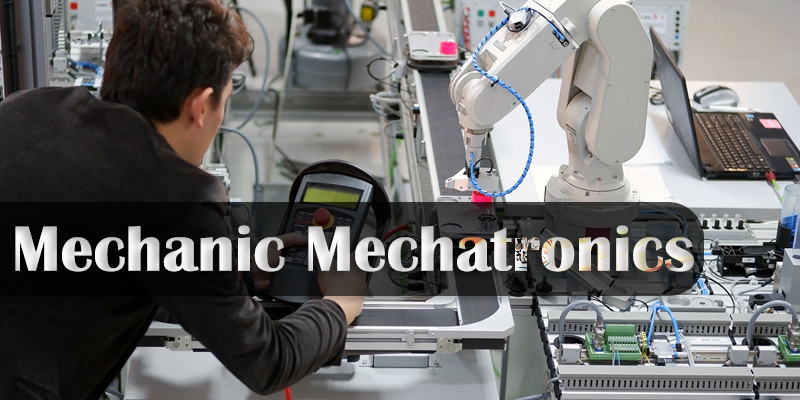
Mechanic Mechatronics
Syllabus:
Trade Type:
Trades Duration:
JOB ROLE
The breakdown cost of CNC machines and other Mechatronics systems is very high. The role of Mechanic Mechatronics is very important in the industry to keep the breakdown cost to minimum.
The job roles expected from Mechanic Mechatronics is described below:
- To repair and maintain CNC machines and other Mechatronics systems in working condition.
- To analyze the alarm messages displayed by the CNC system, to take backup of NC/PLC / Drive data, to install drives (axis & spindle) and to initiate necessary action to solve the problem.
- To establish communication between the CNC controller & PC through Ethernet Port, create new alarm msgs and read the various machine parameters
- Read and understand the circuit diagrams of hydraulics, pneumatics, PLC system, electrical and electronics to analyze the problem for solution.
- To coordinate with the production section to ensure strict adherence to the daily, weekly, quarterly maintenance schedules of the CNC machines and other Mechatronics systems to avoid costly breakdowns.
- To plan and execute preventive maintenance of CNC machines and other Mechatronics systems to avoid breakdowns.
- To dismantle Mechatronics systems like spindle assembly, ball screw, gear box, feed mechanism, lubrication system, coolant system, feedback devices, check different parts, make necessary repairs and reassemble the systems.
- To check the repaired and reassembled systems for proper functioning and fit them in the machine.
- To advice management in maintenance of necessary spares inventory of CNC machines to reduce breakdown time.
LEARNING OUTCOM
The following are minimum broad Common Occupational Skills/ Generic Learning Outcome after completion of the MECHANIC MECHATRONICS course of 02 years duration under ATS.
Block I & II:-
- 1. Recognize & comply safe working practices, environment regulation and housekeeping. 2. Understand and explain different mathematical calculation & science in the field of study including basic electrical. [Different mathematical calculation & science -Work, Power & Energy, Algebra, Geometry & Mensuration, Trigonometry, Heat & Temperature, Levers & Simple machine, graph, Statistics, Centre of gravity, Power transmission, Pressure]
- 3. Interpret specifications, different engineering drawing and apply for different application in the field of work. [Different engineering drawing-Geometrical construction, Dimensioning, Layout, Method of representation, Symbol, scales, Different Projections, Machined components & different thread forms, Assembly drawing, Sectional views, Estimation of material, Electrical & electronic symbol]
- 4. Select and ascertain measuring instrument and measure dimension of components and record data.
- 5. Explain the concept in productivity, quality tools, and labour welfare legislation and apply such in day to day work to improve productivity & quality.
- 6. Explain energy conservation, global warming and pollution and contribute in day to day work by optimally using available resources.
- 7. Explain personnel finance, entrepreneurship and manage/organize related task in day to day work for personal & societal growth.
- 8. Plan and organize the work related to the occupation.
SPECIFIC LEARNING OUTCOME
Block – I
- 1. Filing skills for precision fitting: Surface flatness, perpendicularity, Angular surface, Radius, balancing of file, draw filing, etc.
- 2. Drilling, reaming and tapping skills: on drilling machine, sensitive drilling machine, hand reaming, machine reaming, hand tapping, etc.
- 3. Lathe machine: Maintenance and repairing skills of lathe machine. Dismantling and assembling of gear box, feed mechanism, etc.
- 4. Milling machine: Maintenance and repairing skills of milling machine. Dismantling and assembling of gear box, feed mechanism, etc.
- 5. Grinding machine: Maintenance and repairing skills of grinding machine. Dismantling and assembling of gear box, feed mechanism, etc.
- 6. Drilling machine: Maintenance and repairing skills of bench drilling and pillar type drilling machines.
- 7. Soldering skills, SMD soldering 8. Machine leveling skills for lathe, milling, grinding machines. Test reports against standards.
- 9. Guideways adjustment skills and Machine alignment setting skills: for lathe, milling, grinding machines.
- 10. Bearing Maintenance: mounting of bearings with proper fit & axis alignment, bearing removal from shafts, use of proper tools like pullers, etc.
- 11. Dismantling, maintenance, repair and assembling skills of simple mechanisms such as machine vice, three jaw chuck, tail stock, index head, coolant pump, etc.
- 12. Gear repairing and fitting skills: spur, helical, bevel gears, worm and worm wheels, rack and pinion, etc.
- 13. Test various electrical/electronic components using proper measuring instruments.
- 14. Assemble various electronic circuits using SMD components and test them using suitable test equipment and perform the repair work on the PCB tracks.
Block – II
- 15. Understand and apply the principle of electronic sensors, mechanical actuators and computer control. Install, test, and troubleshoot sensors, switches, and other control devices.
- 16. Hydraulic circuits: reading and construction skills, setting of hydraulic elements for proper functioning, trouble shooting in hydraulics, repair and maintenance of hydraulic valves, etc.
- 17. Pneumatic circuits: reading and construction skills, setting of pneumatic elements for proper functioning, trouble shooting in Pneumatics, repair and maintenance of pneumatic valves, etc.
- 18. Understand pnuematic/hydraulic and VFD/electric-motor control diagrams and construct them with appropriate hardware.
- 19. Install, integrate and troubleshoot servo and stepper motor controls
- 20. Understand and apply program on mechatronics modules and systems, especially PLCs, connect and configure PLC networks and data transfer using bus systems.
- 21. Understand and apply the principle of operation of mechatronics systems
- 22. Demonstration of the procedure of Installation and commissioning of CNC machine.
- 23. CNC Machine spindle assembly: spindle play setting, runout inspection, repair, etc.
- 24. Ball screw assembly: ball screw mounting, preloading, assembling, lubrication, dismantling, repair, etc.
- 25. Feedback devices: proper setting, repair and maintenance of feedback elements, etc.
- 26. Lubrication & Coolant system of CNC Machines: Centralized lubrication system, friction, guide ways, repair, etc.
- 27. Preventive maintenance skills of CNC machines: Daily, weekly, quarterly maintenance schedules to avoid breakdowns.
- 28. Understand and apply CNC Programming
NOTE: Learning outcomes are reflection of total competencies of a trainee and assessment will be carried out as per assessment criteria

| Workshop Calculation Semester 1 Jan 2018 |
| Workshop Calculation & Science Sem 2 Jan 2018 |
| Workshop Calculation Semester 3 July 2018 |
| Workshop Calculation Semester 3 Jan 2018 |

| Engg Drawing Semester 1 July 2017 |
| Engg Drawing Semester 4 July 2018 |
| Engg Drawing Semester 4 July 2017 |
| Engg Drawing Semester 4 January 2018 |
| Engg Drawing Semester 3 July 2018 |

Employability Skills Work Book
- AI को समझना
- AI कैसे काम करता है?
- AI क्या कर सकता है?
- AI के प्रकार
- AI से जुड़े करियर के बारे में जानना
- AI के साथ सीखना
- AI का ज़िम्मेदारी से इस्तेमाल
- AI क्या है?
| आईटीआई एम्प्लॉयबिलिटी स्किल्स 2019 - प्रश्न पत्र सेट 23 |
| आईटीआई एम्प्लॉयबिलिटी स्किल्स 2019 - प्रश्न पत्र सेट 24 |
| आईटीआई एम्प्लॉयबिलिटी स्किल्स 2019 - प्रश्न पत्र सेट 25 |

Search engine adsence
Funny Video Play
Fifty Shades Of Bosses | Happy Boss' Day