
Technician Power Electronics System
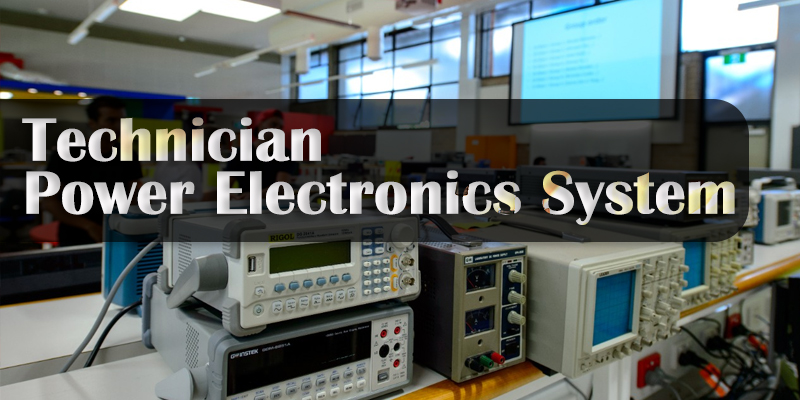
During the two years duration of Technician Power Electronics Systems trade, a candidate is trained on Professional Skill, Professional Knowledge, Engineering Drawing, Workshop Calculation & Science and Employability Skill. In addition to this, a candidate is entrusted to undertake project work and extracurricular activities to build up confidence. The broad components covered related to the trade are categorized in four semesters each of six months duration. The semester wise course coverage is categorized as below:
1stSemester – In this semester, the trainee learns about safety and environment, use of fire extinguishers, artificial respiratory resuscitation to begin with. He gets the idea of trade tools & its standardization, familiarize with basics of electricity, test the cable and measure the electrical parameter. Skilling practice on different types & combination of cells for operation and maintenance of batteries being done. Identify and test passive and active electronic components. Construct and and de-soldering of various PCBs. Assemble a computerest unregulated and regulated power supplies. Practice soldering types of electrical and electronic components on through-hole system, install OS, Practice with MS office. Use the internet, browse, create mail IDs, download desired data from internet using search engines.
2nd Semester - In this semester, the candidate will be able to construct and test amplifier, oscillator and wave shaping circuits. Testing of power electronic components. Construct and test power control circuits. Identify and test opto-electronic devices. Able to achieve the skill on SMD Soldering and De-soldering of discrete SMD components. Verifying the truth tables of various digital 1Cs by referring Data book. ractice circuit simulation software to simulate and test various circuits. Identify various types of LEDS, LED displays and interface them to a digital counter and test. Construct and test various circuits using linear ICs 741 & 555.
3rd Semester - In this semester, the trainee will be able to operate DSO and perform various functions. Gaining the skill by practicing SMD Soldering and De-soldering. Introduction with protection devices. Familiarize with the instruction set of 8051 microcontroller. Interface a model application with the Microcontroller kit and run the application. Working with three phase rectifier, chopper, SMPS, inverters and UPS. Interpret electrical control circuits used in industries. Installation and setup of fibre-optic communication system. Identify construction of various electro-pneumatic circuits. Make simple project applications using 1Cs, transformer and other discrete components.
4th Semester – In this semester, the trainee will work on installing a solar panel, execute testing and evaluate performance by connecting the panel to the inverter. Operation of different process sensor, identify, wire & test various sensors of different industrial processes by selecting appropriate test instruments. Assemble, test & troubleshoot various digital controlled field devices and execute the result. Perform speed control of DC machine and single phase and 3-phase AC machines. Install, configure and check the performance of AC and DC drive to control the speed. Perform speed control of servo motor and test different industrial process circuit by selecting the suitable function. Install, test & control the Electro-Pneumatic actuators using various pneumatic valves. Execute the operation of different indication on PLC modules and wire different field devices of PLC and configure the system and perform the suitable function.
JOB ROLE
Electronics Fitter, General fits, assembles and repairs various kinds of electronic equipment in factory or workshop or at place of use. Examines drawings and wiring diagrams; checks parts for accuracy of fit and minor adjustments; assembles parts or mounts them on chassis or panels with aid of hand tools; installs and connects wiring, soldering joints equipment, diagnoses faults with aid of electronic testing equipment; dismantles equipment if required and replaces faulty parts or wiring.
Electronics Fitter, other include all other workers engaged in fitting, assembling, repairing and maintaining electronic equipment, machinery, appliances, etc., not elsewhere classified.
Electronics Mechanic; Electronic Equipment Mechanic repairs electronic equipment, such as computers, industrial controls, transmitters and telemetering control systems following blueprints and manufacturer's specifications and using hand tools and test instruments. Tests faulty equipment and applies knowledge of functional operation of electronic units and systems to diagnose cause of malfunction. Tests electronic components and circuits to locate defects, using instruments, such as oscilloscopes, signal generators, ammeters and voltmeters. Replaces defective components and wiring and adjusts mechanical parts, using hand tools and soldering iron. Aligns, adjusts and calibrates testing instruments. Maintains records of repairs, calibrations and test.
Solar Panel Installation Technician is also known as ‘Panel Installer’, the Solar Panel Installation Technician is responsible for installing solar panels at the customers’ premises. The individual at work checks the installation site, understands the layout requirement as per design, assesses precautionary measures to be taken, installs the solar panel as per customer’s requirement and ensures effective functioning of the system post installation.
Optical Fiber Technician is responsible for maintaining uptime and quality of the network segment (both optical media and equipment) assigned to him by undertaking periodic preventive maintenance activities and ensuring effective fault management in case of fault occurrence. He is also required to coordinate activities for installation and commissioning of Optical Fibre Cable (OF) as per the route plan.
Field Technician: UPS and Inverter is also called, ‘UPS Repair Technician’, this is an after sales service job for installing and providing support to customers of different types of UPS and inverters. The individual at work installs the newly purchased UPS or inverter. The individual also interacts with customers to diagnose problems in them, assesses possible causes, rectifies faults or replaces faulty modules or recommends factory repairs for bigger faults as per the route plan.
PLC Assembly Operator; is responsible for completing the printed circuit board (PCB) and box assembly of the PLC components. The individual at work assembles the power supply and micro-controller PCBs, sends them for programming and completes the box assembly thereafter.
Plan and organize assigned work and detect & resolve issues during execution. Demonstrate possible solutions and agree tasks within the team. Communicate with required clarity and understand technical English. Sensitive to environment, self-learning and productivity.
GENERIC LEARNING OUTCOME
- The following are minimum broad Common Occupational Skills/ Generic Learning Outcome after completion of the Electronic Mechanic course of 02 years duration:
- 1. Apply safe working practices.
- 2. Comply with environment regulation and housekeeping.
- 3. Interpret & use company and technical communication.
- 4. Demonstrate basic mathematical concepts and principles to perform practical operations.
- 5. Understand and explain basic science in the field of study including simple machines.
- 6. Read and apply engineering drawing for different application in the field of work.
- 7. Understand and apply the concept in productivity, quality tools, and labour welfare legislation in day-to-day work to improve productivity & quality.
- 8. Explain energy conservation, global warming and pollution and contribute in dayto-day work by optimally using available resources.
- 9. Explain personnel finance, entrepreneurship and manage/organize related task in day-to-day work for personal & societal growth.
- 10. Utilize basic computer applications and internet to take benefit of IT developments in the industry
SPECIFIC LEARNING OUTCOME
- 11. Perform basic workshop operations using suitable tools for fitting, riveting, drilling etc. observing suitable care & safety.
- 12. Select and perform electrical/ electronic measurement of single range meters and calibrate the instrument.
- 13. Test & service different batteries used in electronic applications and record the data to estimate repair cost.
- 14. Plan and execute soldering & de-soldering of various electrical components like Switches, PCB & Transformers for electronic circuits.
- 15. Test various electronic components using proper measuring instruments and compare the data using standard parameter.
- 16. Assemble simple electronic power supply circuit and test for functioning.
- 17. Install, configure, interconnect given computer system(s) and demonstrate and utilize application packages for different application.
- 18. Plan and carry out the selection of a project, assemble the project and evaluate performance for domestic/commercial applications.
- 19. Construct, test and verify the input/output characteristic of various analog circuits.
- 20. Plan and construct different power electronic circuits and analyse the circuit functioning.
- 21. Select the appropriate opto-electronics components and verify the characteristics in different circuit.
- 22. Assemble, test and troubleshoot various digital circuits.
- 23. Simulate and analyze the analog and digital circuits using Electronic simulator software.
- 24. Identify, place, solder and desolder and test different SMD discrete components and IC’s package with due care and following safety norms using proper tools/setup.
- 25. Construct and test different circuits using IC 741 Operational amplifiers & IC 555 linear integrated circuits and execute the result.
- 26. Measure the various parameters by DSO and execute the result with standard one.
- 27. Rework on PCB after identifying defects from SMD soldering and de-soldering.
- 28. Construct different electrical control circuits and test for their proper functioning with due care and safety.
- 29. Test, service and troubleshoot the various components of different domestic/ industrial programmable systems.
- 30. Plan and interface the LCD/ LED/ DPM panels to various circuits and evaluate performance.
- 31. Assemble, test and troubleshoot single phase & 3-phase controlled and uncontrolled rectifier using SCR.
- 32. Construct, test & repair different chopper using MOSFET and IC based DC-DC converter and execute the result.
- 33. Detect the faults and troubleshoot Power supplies, SMPS, UPS and inverter.
- 34. Prepare fiber optic setup and execute transmission and reception.
- 35. Install a solar panel, execute testing and evaluate performance by connecting the panel to the inverter.
- 36. Execute the operation of different process sensor, identify, wire & test various sensors of different industrial processes by selecting appropriate test instruments.
- 37. Assemble, test & troubleshoot various digital controlled field devices and execute the result.
- 38. Perform speed control of DC machine and single phase and 3-phase AC machines.
- 39. Install, configure and check the performance of AC and DC drive to control the speed.
- 40. Perform speed control of servo motor and test different industrial process circuit by selecting the suitable function.
- 41. Install, test & control the Electro-Pneumatic actuators using various pneumatic valves.
- 42. Execute the operation of different indication on PLC modules and wire different field devices of PLC and configure the system and perform the suitable function.

| Workshop Calculation Semester 1 Jan 2018 |
| Workshop Calculation & Science Sem 2 Jan 2018 |
| Workshop Calculation Semester 3 July 2018 |
| Workshop Calculation Semester 3 Jan 2018 |

| Engg Drawing Semester 1 July 2017 |
| Engg Drawing Semester 4 July 2018 |
| Engg Drawing Semester 4 July 2017 |
| Engg Drawing Semester 4 January 2018 |
| Engg Drawing Semester 3 July 2018 |

Employability Skills Work Book
- AI को समझना
- AI कैसे काम करता है?
- AI क्या कर सकता है?
- AI के प्रकार
- AI से जुड़े करियर के बारे में जानना
- AI के साथ सीखना
- AI का ज़िम्मेदारी से इस्तेमाल
- AI क्या है?
| आईटीआई एम्प्लॉयबिलिटी स्किल्स 2019 - प्रश्न पत्र सेट 23 |
| आईटीआई एम्प्लॉयबिलिटी स्किल्स 2019 - प्रश्न पत्र सेट 24 |
| आईटीआई एम्प्लॉयबिलिटी स्किल्स 2019 - प्रश्न पत्र सेट 25 |
