
Tool & Die Maker (Press Tools, Jigs & Fixtures)
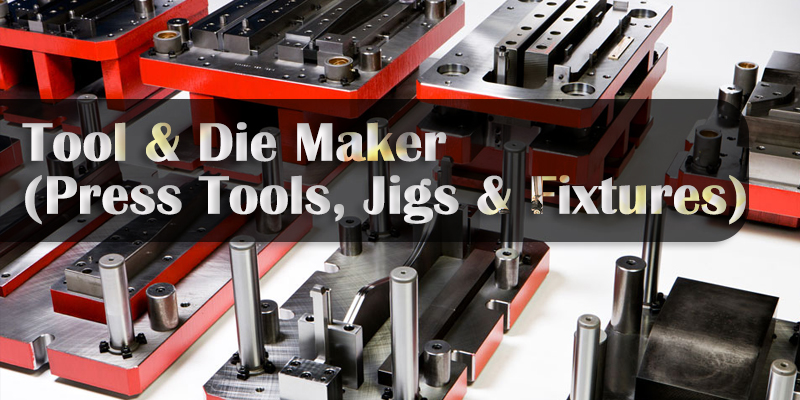
ITI trade Tool & Die Maker (Press Tools, Jigs & Fixtures) is powered by NCVT. ITI trade Tool & Die Maker (Press Tools, Jigs & Fixtures) is a job oriented trade ITI trade Tool & Die Maker (Press Tools, Jigs & Fixtures) is suitable for government job and private job. This ITI trade Tool & Die Maker (Press Tools, Jigs & Fixtures) is very powerful for self-empowerment. This ITI trade Tool & Die Maker (Press Tools, Jigs & Fixtures) is perfectly design to fulfill industrial requirement of Indian Industries as well as International industries.
During the two years duration, a candidate is trained on subjects- Professional Skill, Professional Knowledge, Engineering Drawing, Workshop Science & Calculation and Employability Skills. In addition to this, a candidate is entrusted to make/do project work and Extra Curricular Activities to build up confidence. The practical skills are imparted in simple to complex manner & simultaneously theory subject is taught in the same fashion to apply cognitive knowledge while executing task.
The course covers the detail aspect of mould making& testing. The broad components covered under Professional Skill subject are as below:
1st Semester– The practical part starts with basic fitting covering components like filing, sawing, drilling, tapping, chipping, grinding and different fits. The accuracy proposed is of ±0.05mm and angular accuracy of 1. Different turning operations on lathe viz., plain, facing, boring, grooving, step turning, parting, chamfering, knurling and different thread cutting by setting the different parameter, are covered in the practical part.
2ndSemester– Different milling operations (plain, stepped, angular, dovetail, T-slot, contour, gear) along with surface & cylindrical grinding to an accuracy of ±0.02mm are covered. In addition, solid modeling of mould in CAD & Pro E taught setting and execution of welding is also a component in this semester.
3rdSemester– Setting, operation and programming of CNC turn centre and CNC machining centre to produce components are performed in this semester. 2D & 3D machining with CAM software is also performed. Manufacture drill jig and fixture is also part of the practical. EDM & wire EDM operation to produce components with an accuracy of ±0.02mm is covered. Construction of blanking and piercing tool is done and testing of same is also performed.
4th Semester– Basic construction of Hydraulic & Pneumatic circuits and basic functioning of electrical circuit and sensors are covered in this semester. Construction of compound and progressive tools is done testing of same is executed. Simple repair and overhauling of different machines viz., drill, milling & lathe is covered. Making of ‘V’ bending tool and draw tool are carried out and testing is also undertaken.
The Directorate General of Training (DGT) under Ministry of Skill Development & Entrepreneurship offers a range of vocational training courses catering to the need of different sectors of Labour market. The vocational training programmes are running under the aegis of National Council of Vocational Training (NCVT). Craftsman Training Scheme (CTS) and Apprenticeship Training Scheme (ATS) are two pioneer programmes under NCVT for propagating vocational training.
TOOL & DIE MAKER (Press Tools and Jigs & Fixtures)trade under CTS is one of the popular courses delivered nationwide through network of ITIs. The course is of two years (04 semester) duration. It mainly consists of Domain area and Core area. In the Domain area, Trade Theory & Practical impart professional skills and knowledge, while Core area imparts Workshop Calculation and Science, Engineering Drawing and Employability Skills impart requisite core skill & knowledge and life skills. After passing out the training programme, the trainee is awarded National Trade Certificate (NTC) by NCVT which is recognized worldwide.
Candidates broadly need to demonstrate that they are able to:
- Read & interpret technical parameters/documentation, plan and organize work processes, identify necessary materials and tools;
- Perform task with due consideration to safety rules, accident prevention regulations and environmental protection stipulations;
- Apply professional knowledge, core skills & employability skills while performing the job of a Tool & Die Maker (Press Tools and Jigs & Fixtures) and machining work.
- Check the job/components as per drawing for functioning identify and rectify errors in job/components.
- Document the technical parameters related to the task undertaken
JOB ROLE
Tool & Die Maker (Press Tools, Jigs & Fixtures): Tool and Die Makers build, repair and modify custom made prototypes or special tools, Press Tools, Jigs, Fixtures and various types of mechanical devices. Press Tools are metal forms used for Sheet metal cutting and forming. Tool and Die Makers fabricate various parts, like pieces of a puzzle, which require perfect fitting. While this occupation is closely allied with the machinist trade and encompasses many of the same skills, Tool and Die Makers usually specialize in jobs spending more time in fitting and assembling precision components which are required for sheet metal cutting forms. A Tool and Die maker’s work depends on precise measurements and accuracy, as such math skills are important. Also, they must be able to read and interpret information from design drawings and specifications to fabricate all types of Press Tools Jigs and Fixtures. Being mechanical minded is an additional skill.
Plan and organize assigned work; and detect and resolve issues during execution. Demonstrate possible solutions and agree tasks within the team. Communicate with required clarity and understand technical English, sensitive to environment, self-learning and productivity
The trainee after completion of this course may be designated as Tool & Die Maker (Press Tools, Jigs & Fixtures) according to nature of work done.
NSQF LEVEL COMPLIANCE
NSQF level for Tool & Die Maker (Press Tools, Jigs & Fixtures) trade under CTS: Level 5 As per notification issued by Govt. of India dated 27.12.2013 on National Skill Qualification Framework total 10 (Ten) Levels are defined. Each level of the NSQF is associated with a set of descriptors made up of five outcome statements, which describe in general terms, the minimum knowledge, skills and attributes that a learner needs to acquire in order to be certified for that level. Each level of the NSQF is described by a statement of learning outcomes in five domains, known as level descriptors. These five domains are:
a. Process
b. Professional Knowledge
c. Professional Skill
d. Core Skill
e. Responsibility
The broad learning outcome of Tool & Die Maker (Press Tools, Jigs & Fixtures) trade under CTS mostly matches with the Level descriptor at Level- 5.
LEARNING OUTCOME
- 1. Recognize & comply with safe working practices, environment regulation and housekeeping.
- 2. Understand and explain different mathematical calculation & science in the field of study. [Different mathematical calculation & science -Work, Power & Energy, Algebra, Geometry & Mensuration, Trigonometry, Heat & Temperature, Levers & Simple machine, graph, Statistics, Centre of gravity, Power transmission, Pressure]
- 3. Interpret specifications, different engineering drawing and apply for different application in the field of work. [Different engineering drawing-Geometrical construction, Dimensioning, Layout, Method of representation, Symbol, scales, Different Projections, Machined components & different thread forms, Assembly drawing, Sectional views]
- 4. Select and ascertain measuring instrument and measure dimension of components and record data.
- 5. Explain the concept in productivity, quality tools, and labour welfare legislation and apply such in day-to-day work to improve productivity & quality.
- 6. Explain energy conservation, global warming and pollution and contribute in day-to-day work by optimally using available resources.
- 7. Explain personnel finance, entrepreneurship and manage/organize related task in day-today work for personal & societal growth.
- 8. Plan and organize the work related to the occupation.
- 9. Interpret specifications, different Dies & Moulds design drawing and apply for different application in the field of work. [Different Tool Design Drawing-Hand injection moulds, Mould base, two cavity injection mould in different constructional featured,]
Semester – I
- 10. Plan and organize the work to make job as per specification applying different types of basic fitting operation and check for dimensional accuracy. [Basic fitting operation – Filing, Marking, Hack sawing, Drilling, Taping, chipping and Grinding etc. Accuracy: ± 0.1mm]
- 11. Make different fit of components for assembling as per required tolerance observing principle of interchangeability and check for functionality. [Different Fit –Open, Angular, & Square Fit; Required tolerance: ±0.05 mm, angular tolerance: 1 degree.]
- 12. Set different shaped jobs on different chuck and demonstrate conventional lathe machine operation observing standard operation practice. [Different chucks:3 jaws & 4 jaws, different shaped jobs: round, square, hexagonal]
- 13. Prepare different cutting tool to produce jobs to appropriate accuracy by performing different turning operations. Different cutting tool – V tool, side cutting, parting, thread cutting (both LH & RH),Appropriate accuracy: ±0.06mm, Different turning operation – Plain, facing, drilling, boring (counter & stepped), grooving, Parallel Turning, Step Turning, parting, chamfering, U -cut, Reaming, internal recess, knurling.
- 14. Set the different machining parameters to produce threaded components applying method/ technique and test for proper assembly of the components with an accuracy of ± 0.05 mm. [Different threads viz., metric/ BSW/ Square]
Semester – II
- 15. Set the different machining parameters and cutters to prepare job by performing different milling operation and indexing. [Different machining parameters – feed, speed and depth of cut. Different milling operations – plain, stepped, angular, dovetail, T-slot, contour, gear milling]
- 16. Produce components of high accuracy by surface grinding operation.[Accuracy of +/- 0.02 mm]
- 17. Produce components of high accuracy by cylindrical grinding operations. [Accuracy of +/- 0.02mm.]
- 18. Sharpen different cutter or multipoint cutting tool. [Different cutters – end mill cutter, side & face milling cutter, single angle cutter, Reamer]
- 19. Develop isometric drawing and solid modelling of mould using CAD & Pro-E.
- 20. Set the welding plant with appropriate parameters & perform different welding operations.[Appropriate parameter- electrode size, voltage, current, position, travel speed, torch angle.]
Semester – III
- 21. Manufacturing of drill Jig and produce component on drill machine by using Jigs and check for correctness. (Simple template & Plate Jig) 22. Manufacturing of fixtures (milling, turning and grinding) & test.
- 23. Set (both job and tool) CNC turning centre and produce components as per drawing by preparing part programme
- 24. Set (both job and tool) CNC machining centre vertical and produce components as per drawing by preparing part programme.
- 25. Perform 2D & 3D machining with CAM software.
- 26. Produce components using Electric Discharge Machine (EDM) and Wire EDM as per drawing by preparing part programme with accuracy of ± 0.02mm.
- 27. Manufacturing of blanking (simple) die set for square/ round/ rectangular/elliptical component and verify the component.
- 28. Construct a Piercing & Blanking tool & test and verify the component
Semester – IV
- 29. Construct circuit of pneumatics and hydraulics observing standard operating procedure and safety aspect.
- 30. Demonstrate function of basic electrical circuit and sensors.
- 31. Construct a Compound Tool & test and verify the component.
- 32. Construct a Progressive tool & test and verify the component.
- 33. Plan and perform simple repair, overhauling of different machines and check for functionality. [Different Machines – Drilling Machine, milling machine and Lathe]
- 34. Manufacture “V” bending tool & test.
- 35. Construct a draw tool (single stage) and test to verify the component.

| Workshop Calculation Semester 1 Jan 2018 |
| Workshop Calculation & Science Sem 2 Jan 2018 |
| Workshop Calculation Semester 3 July 2018 |
| Workshop Calculation Semester 3 Jan 2018 |

| Engg Drawing Semester 1 July 2017 |
| Engg Drawing Semester 4 July 2018 |
| Engg Drawing Semester 4 July 2017 |
| Engg Drawing Semester 4 January 2018 |
| Engg Drawing Semester 3 July 2018 |

Employability Skills Work Book
- AI को समझना
- AI कैसे काम करता है?
- AI क्या कर सकता है?
- AI के प्रकार
- AI से जुड़े करियर के बारे में जानना
- AI के साथ सीखना
- AI का ज़िम्मेदारी से इस्तेमाल
- AI क्या है?
| आईटीआई एम्प्लॉयबिलिटी स्किल्स 2019 - प्रश्न पत्र सेट 23 |
| आईटीआई एम्प्लॉयबिलिटी स्किल्स 2019 - प्रश्न पत्र सेट 24 |
| आईटीआई एम्प्लॉयबिलिटी स्किल्स 2019 - प्रश्न पत्र सेट 25 |
