
Types of Bearings
Submitted by Anand on 13 August 2022 - 1:02pm
Classification of Bearings
There are three main classifications of bearings, according to the direction of load, viz.,
- Journal or radial bearing,
- Footstep bearing,
- Thrust or collar bearing.
- A journal or radial bearing afford support to the shaft at a right angle to the shaft axis.
- A footstep or pivot bearing support shaft is parallel to the shaft axis, and the end of the shaft rests on the bearing surfaces.
- A thrust or collar bearing supports the shaft subjected to end or axial thrust.
The surfaces of the bearing are generally flat or cylindrical. And they may consist of nonferrous metal surfaces known as bushes or hardened steel races supported by steel balls or rollers. In the above case, the bearing is known as bush bearings, and the latter is known as a ball or roller bearings.
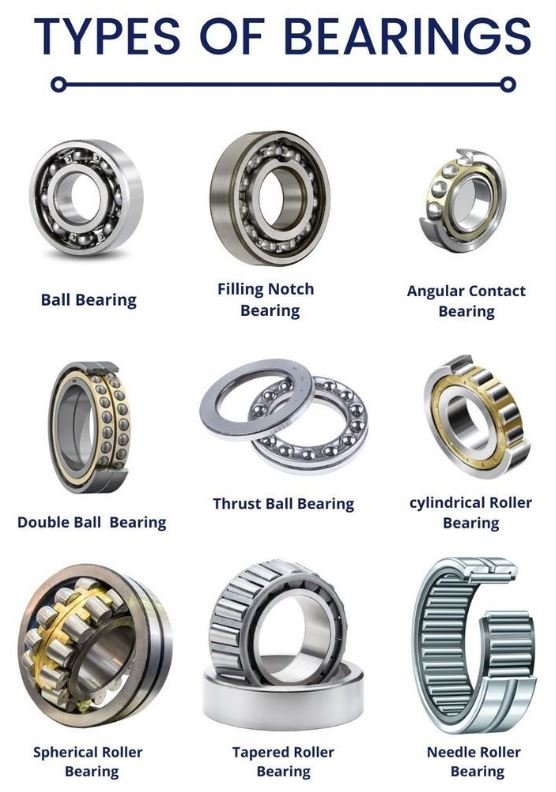
Types of Bearings
Following are the different types of bearings:
- Ball bearing
- Bush Bearing
- Thrust Bearing
- Foot Step Bearing
- Rolling contact or Anti-friction Bearing
- Roller bearing
- Cylindrical roller bearing
- Tapered roller bearing
- Needle roller bearing
- Plain bearing
- Linear bearing
- Fluid bearing
- Magnetic bearing
- Jewel bearing
- Flexure bearing

| Workshop Calculation Semester 1 Jan 2018 |
| Workshop Calculation & Science Sem 2 Jan 2018 |
| Workshop Calculation Semester 3 July 2018 |
| Workshop Calculation Semester 3 Jan 2018 |

| Engg Drawing Semester 1 July 2017 |
| Engg Drawing Semester 4 July 2018 |
| Engg Drawing Semester 4 July 2017 |
| Engg Drawing Semester 4 January 2018 |
| Engg Drawing Semester 3 July 2018 |

Employability Skills Work Book
- AI को समझना
- AI कैसे काम करता है?
- AI क्या कर सकता है?
- AI के प्रकार
- AI से जुड़े करियर के बारे में जानना
- AI के साथ सीखना
- AI का ज़िम्मेदारी से इस्तेमाल
- AI क्या है?
| आईटीआई एम्प्लॉयबिलिटी स्किल्स 2019 - प्रश्न पत्र सेट 23 |
| आईटीआई एम्प्लॉयबिलिटी स्किल्स 2019 - प्रश्न पत्र सेट 24 |
| आईटीआई एम्प्लॉयबिलिटी स्किल्स 2019 - प्रश्न पत्र सेट 25 |

Search engine adsence
Funny Video Play
Thoughts That Go In Your Head When HR Calls Regarding A Job Vacancy
Comments
Anand
11 April 2025 - 7:56pm
Permalink
Classification and Types of Bearings
Classification and Types of Bearings (For ITI Students)
Bearings are one of the most essential components used in mechanical engineering. In simple terms, a bearing is a mechanical part that supports a rotating or moving part and helps reduce friction between the moving part and the stationary part. Bearings are used in almost every machine – from bicycles and fans to cars and industrial machinery. Understanding the types and classification of bearings is crucial for ITI students, especially those studying in mechanical, fitter, or electrician trades.
What is a Bearing?
A bearing is a device that supports a load and allows motion between two parts, usually a rotating shaft and a stationary housing. It reduces friction and wear, enhances efficiency, and ensures smooth movement of the shaft.
Classification of Bearings
Bearings are classified based on the direction of the load they support. The main classifications are:
1. Journal or Radial Bearing
This type of bearing supports the shaft in a direction that is at a right angle (90 degrees) to the shaft axis. In other words, it bears the radial load of the shaft. These are the most commonly used bearings in machines like motors, engines, and pumps.
Example: The bearings used in electric motors are usually radial bearings.
2. Footstep or Pivot Bearing
This type of bearing supports the shaft in a vertical position. The end of the shaft rests on the bearing surface, and the load is along the same direction as the shaft axis. This is used when the shaft is in a standing position and is subjected to vertical loads.
Example: Vertical turbines and vertical pumps use footstep bearings.
3. Thrust or Collar Bearing
This type of bearing is designed to handle axial loads – loads that are applied along the shaft’s axis. It supports the shaft against end thrust. These bearings are used in places where a component moves forward or backward along the shaft’s length.
Example: Gearboxes and propeller shafts in vehicles use thrust bearings.
Construction of Bearings
Bearings have different designs and constructions depending on the type of load and application. The bearing surface can be:
The materials used in bearings include:
Types of Bearings
Depending on the design, working principle, and application, bearings are of many types. Below is a detailed list of commonly used bearings:
1. Ball Bearing
Ball bearings use steel balls to reduce friction between moving parts. They can handle both radial and axial loads. These are used in fans, wheels, and electric motors.
2. Bush Bearing
A bush bearing is a plain bearing made from bronze or brass. It has no rolling element and relies on lubrication. It is simple, low-cost, and used in agricultural and small machinery.
3. Thrust Bearing
This bearing is designed to take axial loads. It is used in car gear systems, water pumps, and helicopter rotors.
4. Footstep Bearing
Also called a pivot bearing, this supports a vertical shaft at its base. It is used in vertical shafts of machines like vertical turbines.
5. Rolling Contact or Anti-Friction Bearing
These bearings use rolling elements like balls or rollers between races (metal rings). They reduce friction more effectively and are widely used in modern machinery.
6. Roller Bearing
Roller bearings use cylindrical or tapered rollers instead of balls. They can handle heavier radial loads and are used in conveyor belts, machine tools, and heavy-duty equipment.
7. Cylindrical Roller Bearing
This type of bearing uses cylindrical rollers and is suitable for high-speed applications with heavy radial loads.
8. Tapered Roller Bearing
Tapered roller bearings can handle both radial and axial loads. They are widely used in vehicle wheel hubs, gearboxes, and mining equipment.
9. Needle Roller Bearing
This is a type of roller bearing with very thin and long rollers. It is used in automotive components, two-wheelers, and gearboxes where space is limited.
10. Plain Bearing
These are the simplest type of bearing, having no rolling element. The shaft rotates in a hole or sleeve with lubrication. Common in hinges, toys, and agricultural tools.
11. Linear Bearing
Linear bearings are used when motion is required in a straight line rather than rotation. Common in 3D printers, CNC machines, and automation equipment.
12. Fluid Bearing
This type of bearing uses a thin layer of liquid (oil or air) between surfaces to reduce friction. It is used in high-speed turbines and aerospace applications.
13. Magnetic Bearing
In these bearings, the shaft is levitated using magnetic force, eliminating physical contact. They are used in precision machines and advanced turbines.
14. Jewel Bearing
Used in watches and measuring instruments, these bearings have a small jewel (like sapphire) that reduces friction.
15. Flexure Bearing
This bearing allows motion by bending a material in a flexible way. It is used in small devices requiring very high precision.
Conclusion
Bearings are vital for the smooth and efficient operation of machinery. As an ITI student, especially in trades like Fitter, Machinist, or Mechanic, understanding different types of bearings helps in machine maintenance, fault finding, and selection of correct parts. Bearings may look small, but their role in reducing friction, supporting loads, and ensuring long machine life is huge.
From simple bush bearings in household items to magnetic bearings in space applications, technology around bearings continues to evolve. Always remember to handle, install, and lubricate bearings properly to ensure long-term performance and safety of machines.